

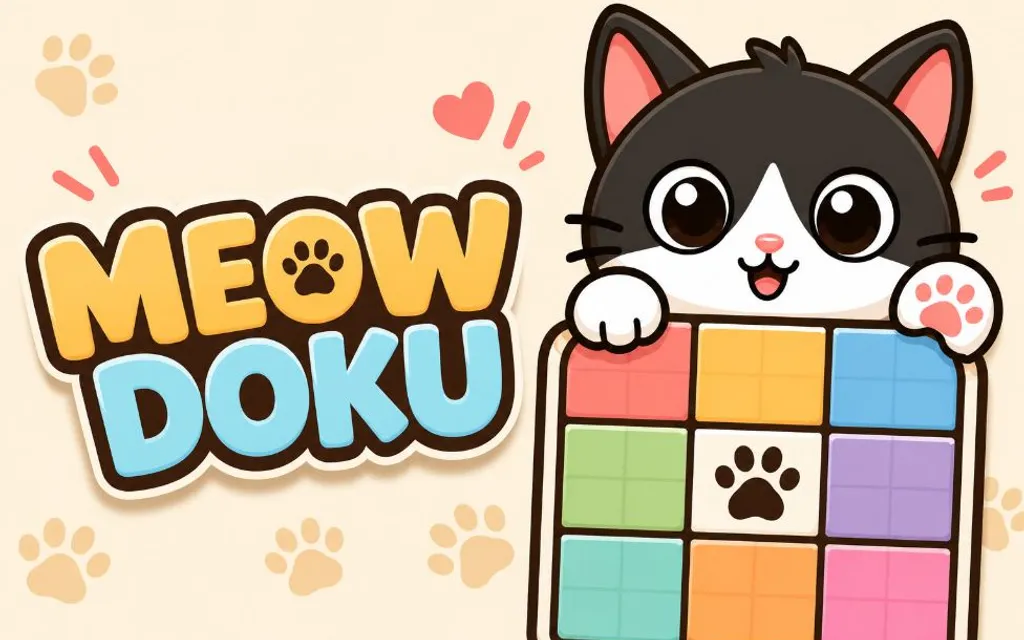
Meowdoku
New Games




The aesthetic presentation of Meowdoku is a deliberate lie designed to lower your guard. Behind the soft colors and feline motifs lies a mathematically brutal spatial reasoning engine based entirely on the classic Eight Queens logic problem. The failure state in Meowdoku is triggered the moment two entities intersect within their defined exclusion zones. Playing Meowdoku requires absolute grid awareness, as a single misplaced unit fundamentally invalidates the entire board structure.
Entering the Grid of Deception
The Eight-Cell Exclusion Zone
The primary mechanic governing Meowdoku is the spatial restriction aura. When you drop a cat onto a specific grid cell, the engine immediately locks out the eight surrounding cells (horizontally, vertically, and diagonally). You cannot place another unit within this immediate perimeter in Meowdoku without triggering a fatal collision error.
This mechanic transforms a simple placement task into a highly restrictive logic puzzle. Placing a unit in the dead center of a 3x3 board in Meowdoku instantly solves the board by eliminating all other options, but it also completely blocks any further placement. To maximize the number of units you can fit on the grid in Meowdoku, you must rigorously adhere to the outer edges.
The difficulty scales exponentially as the grid size expands. In a larger arena, a poorly planned placement in Meowdoku creates dead zones—pockets of empty cells that are rendered permanently unusable because they are overlapped by multiple exclusion auras. You must mathematically visualize the area of effect before you commit to any input in Meowdoku.
Working Backward from Constraints
Brute-forcing your way through the levels in Meowdoku is statistically impossible. To solve the advanced boards, you must utilize the process of elimination. The engine will often pre-place obstacles or specific units on the grid. Rather than figuring out where you can place a unit in Meowdoku, you must systematically identify where you absolutely cannot.
By marking the dead zones generated by the pre-placed elements, the viable squares will naturally reveal themselves in Meowdoku. This inverted logic is critical. If you focus entirely on the open space in Meowdoku, you will inevitably create a cascading spatial conflict that cannot be resolved without a full board wipe.
"The real trick in Meowdoku is to never place a piece until the grid forces you to. Find the corners and the pinch points. If a specific column only has one mathematically viable square left, drop the unit there. Let the constraints dictate your moves, not the other way around."
Mastering the Geometry of Confinement
The Danger of the Center Squares
The most dangerous real estate in Meowdoku is the center of the grid. Because the exclusion aura radiates in all eight directions, a centrally placed unit exerts maximum control over the board. This is disastrous when the objective is to fit a specific quota of units onto the screen in Meowdoku.
To achieve high-efficiency packing in Meowdoku, you must hug the walls. Placing a unit on the exact corner of the board effectively cuts its exclusion zone in half, as the physical boundaries of the grid swallow the rest of the aura. This allows you to stack units much closer together along the perimeter in Meowdoku than you ever could in the middle.
- Corner Placements: Highly efficient in Meowdoku. Eliminates only 3 surrounding usable squares.
- Edge Placements: Moderately efficient. Eliminates 5 surrounding usable squares.
- Center Placements: Highly inefficient. Eliminates all 8 surrounding usable squares in Meowdoku.
Recognizing Unsolvable States
Because you are allowed to place units freely until a collision occurs, it is very common to reach a "zombie state" in Meowdoku. This happens when you have placed 90% of your required units, but the remaining open squares are entirely overlapped by exclusion auras. You have not technically failed yet in Meowdoku, but the board is mathematically unsolvable.
Recognizing these dead ends early is crucial for maintaining your sanity. If you have two units left to place, but all remaining open squares fall within a single 3x3 quadrant in Meowdoku, you must immediately hit the undo button. The physics of the game dictate that you cannot fit two units into a 3x3 space without them touching in Meowdoku.
- Zombie State: The board is technically active, but spatial constraints in Meowdoku make placing the final unit impossible.
- Early Undo: Removing the last two inputs to restructure the central packing arrangement.
The Escalation of Board Complexity
Handling Irregular Grids
While the early stages utilize standard square grids, the late-game levels in Meowdoku introduce irregular, asymmetrical boards. The engine will literally carve out sections of the map, creating bottlenecks and narrow corridors. These missing squares act as hard physical barriers that do not absorb exclusion auras in Meowdoku.
When dealing with irregular shapes in Meowdoku, you must prioritize the narrowest sections first. A 1x3 corridor on the edge of the map can only hold a single unit safely. If you ignore it and let an adjacent aura spill into that corridor in Meowdoku, you effectively delete usable real estate from the board, crippling your final placement capacity.
The logic remains identical, but the visual parsing becomes intensely difficult. You must mentally project the 8-cell radius across jagged edges and missing blocks in Meowdoku, ensuring that your placements in the wide-open areas do not accidentally choke out the narrow choke points.
The Threat of Pre-Placed Modifiers
To completely break your established packing patterns, Meowdoku will occasionally spawn levels with unmovable elements already on the board. These pre-placed assets cannot be shifted, meaning their exclusion zones are permanent. You must build your entire strategy around these immovable anchors in Meowdoku.
Often, these elements are placed in the most mathematically inconvenient locations possible—slightly off-center, or just one square away from a corner. The engine in Meowdoku does this specifically to prevent you from using standard perimeter-packing strategies, forcing you to invent bespoke, asymmetrical solutions on the fly.
Understanding the Underlying Algorithm
The Queens Problem Lineage
Every interaction in Meowdoku is a direct descendant of classical computational logic. The challenge is essentially a modified "N-Queens" puzzle, where the attack vectors are limited to an immediate 1-cell radius rather than extending across the entire board. This means that unlike the classic chess problem, lines of sight do not matter in Meowdoku; only immediate proximity matters.
This subtle shift in rules completely changes the optimal solving algorithm. In standard N-Queens, you use diagonal staggering. In Meowdoku, you use tight, knight-move packing. Placing units at a knight's jump distance (two squares over, one square up) guarantees that their exclusion auras will never intersect in Meowdoku, creating the tightest possible packing density.
| System Specs | Details |
|---|---|
| Developer | Indie Puzzle Dev |
| Release Year | 2023 |
| Genre | Spatial Logic Puzzle |
| Core Interaction | Exclusion Zone Management |
Overcoming Cognitive Fatigue
The primary reason players fail in the late stages of Meowdoku is sheer cognitive overload. Keeping track of dozens of overlapping 8-cell invisible boundaries requires immense short-term memory. When the board scales up to 10x10 or larger in Meowdoku, your brain simply drops variables.
To combat this, you must rely on localized solving. Do not look at the entire board in Meowdoku. Focus entirely on sealing off a single 4x4 quadrant, ensuring it is packed to maximum efficiency without spilling auras into the adjacent sectors. Once a quadrant is locked in Meowdoku, treat it as a solid wall and move to the next.