

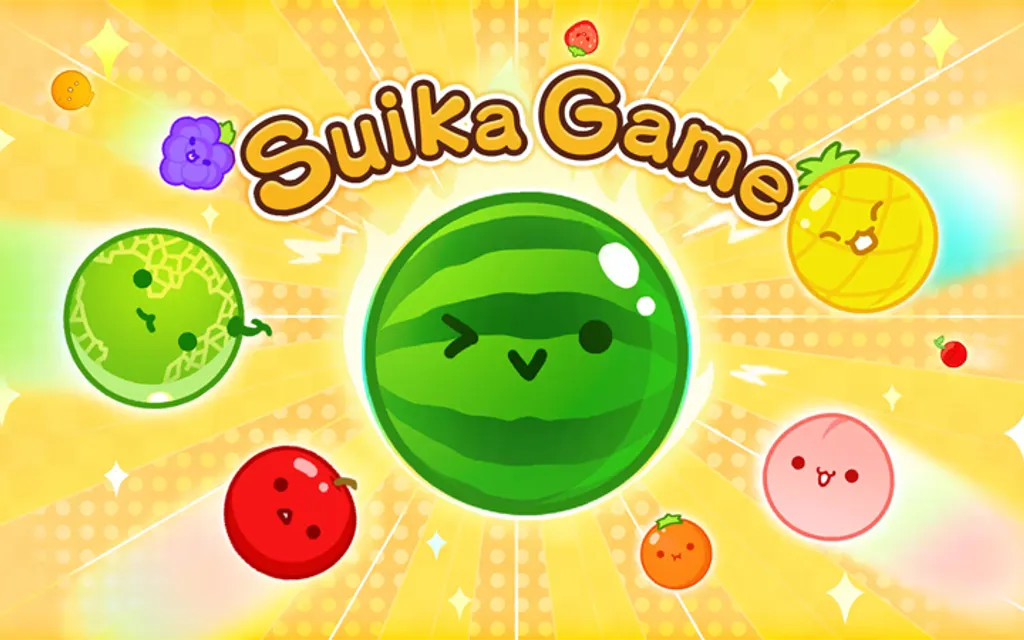
Suika Game
New Games








When scrutinizing core mechanics behind Suika Game, observers quickly realize underlying systems operate far beyond simple tile-matching conventions. Most casual puzzle experiences rely heavily on rigid grid structures and predetermined drop patterns. Suika Game forcefully rejects static grids, opting instead for pure rigid-body physics simulations. Dropping fruits into restricted containers in Suika Game is not merely about matching colors; it represents complex studies in kinetic displacement, bounding box manipulation, and spatial pressure management. Every single action taken in Suika Game unleashes unpredictable chain reactions governed entirely by simulated gravity and collision friction. Players are not just solving puzzles; players are actively wrestling with volatile physics engines designed specifically to maximize chaos as internal pressure builds toward catastrophic overflow.
Deconstructing Rigid-Body Dynamics
Mastering Kinetic Displacement
Primary challenges found within Suika Game stem directly from kinetic displacement. When heavy objects fall into piles of smaller objects, smaller items violently shoot outward. Physics algorithms in Suika Game accurately simulate mass and velocity. Dropping massive apples onto tiny cherries guarantees unpredictable scattering. High-level playstyles in Suika Game require players to anticipate these violent shifts. You must calculate exact angles required to wedge specific fruits between others, intentionally using kinetic force to push trapped targets together.
This mechanical depth transforms Suika Game into highly technical billiards simulators. Veteran players never drop items randomly; they utilize newly spawned fruits as heavy cue balls, precisely striking existing formations to trigger delayed merges deep within piles. Mastering kinetic displacement in Suika Game allows players to salvage seemingly doomed runs by physically forcing uncooperative items into alignment through sheer gravitational bullying.
Managing Spatial Bounding Boxes
Every fruit in Suika Game possesses strict circular bounding boxes. Because circles cannot tessellate perfectly, empty gaps naturally form between stacked items. These empty gaps are lethal hazards. As containers fill up in Suika Game, wasted spatial geometry compounds exponentially, forcing entire piles upward toward failure thresholds. Understanding how different sizes stack efficiently forms foundational strategies for success.
Advanced routing in Suika Game involves meticulous size sorting. Players must actively construct descending staircases of fruit sizes, ensuring smaller items never get permanently trapped beneath larger items. If small cherries become wedged beneath massive melons in Suika Game, they consume valuable bottom-layer volume forever, creating unstable foundations that eventually cause upper layers to violently erupt over container walls.
Suika Game: Physics Engine Specs
| System Specs | Details |
|---|---|
| Developer | Aladdin X |
| Core Engine | 2D Rigid-Body Physics / Collision Simulation |
| Primary Challenge | Kinetic Displacement & Spatial Pressure |
| Failure State | Volumetric Overflow Threshold Breach |
Executing High-Pressure Tactics
Exploiting Merge Eruptions
When two identical items collide in Suika Game, resulting merges generate significant upward kinetic energy. This phenomenon, known as merge eruptions, acts as double-edged swords. Constructing massive chains where multiple merges happen simultaneously will violently shake entire containers. In early stages of Suika Game, these eruptions playfully mix items together. During late-game scenarios where containers are nearly full, unexpected merge eruptions instantly launch items out of bounds, terminating runs prematurely.
Elite players exploit merge eruptions tactically. If specific targets remain stubbornly separated on opposite sides of containers, players intentionally trigger minor merges directly beneath them. Upward kinetic blasts in Suika Game temporarily toss heavy items into mid-air, allowing underlying piles to shift and settle into denser, more efficient configurations. Using explosions to compact wasted space requires immense foresight and deep understanding of collision mathematics native to Suika Game.
"Biggest mistakes newcomers make in Suika Game involve dropping items too quickly. Physics engines require several seconds to fully resolve kinetic energy. Dropping new items before previous collisions finish settling guarantees chaotic bounces and instant run failures. Patience is absolutely mandatory."
Corner Trapping Strategies
Containers in Suika Game feature hard vertical walls. These walls provide absolute stability against lateral rolling. Mastering corner trapping dictates long-term survival. Heavy items must always be relegated to extreme left or right corners. Placing massive items in dead center splits playing fields in half, making it mathematically impossible to maneuver smaller items across gaps.
By aggressively utilizing corner trapping, players in Suika Game artificially create steep sloping walls made of stacked items. These slopes funnel newly dropped items directly into intended collision zones. Managing slopes requires constant maintenance; if slopes become too steep, heavy newly formed items will violently roll down, crushing delicate setups below. Balancing slope angles against volumetric limits constitutes core endgame gameplay loops in Suika Game.
- Queue Monitoring: Always check upcoming item queues in Suika Game. Planning three drops ahead prevents being forced into making suboptimal spatial sacrifices.
- Friction Abuse: Dropping items slightly off-center onto existing curved surfaces in Suika Game generates rotational spin, allowing them to squeeze into tighter gaps.
- Asymmetrical Building: Never build symmetrically. Suika Game demands asymmetrical structures to ensure kinetic energy flows downwards toward specific designated merge zones.
Psychology of Spatial Anxiety
Overcoming Visual Clutter
As containers reach critical capacities, visual designs in Suika Game intentionally induce severe claustrophobia. Brightly colored spheres overlap chaotically, obscuring crucial collision points. Human brains struggle processing overlapping circular geometry efficiently. Suika Game leverages this cognitive weakness, forcing players into making rushed, panic-induced drops during high-pressure moments.
True mastery over Suika Game demands cold emotional detachment. Players must learn to ignore cute visual aesthetics and focus purely on abstract geometric boundaries. By visualizing invisible hitboxes rather than colorful textures, veterans map out precise kinetic vectors. Suika Game rewards stoic calculation while brutally punishing impulsive reactions.
A Benchmark in Physics Puzzle Design
Ultimately, Suika Game stands as phenomenal examples of emergent gameplay generated through simple rule sets interacting with robust physics engines. Lack of traditional timers or arbitrary turn limits means all pressure is entirely player-generated. Engines in Suika Game perfectly simulate consequences of poor spatial planning, creating deeply satisfying feedback loops where players clearly understand exactly why their structural architectures failed.
For players seeking highly technical puzzle experiences demanding both spatial reasoning and deep physics intuition, Suika Game offers unparalleled depth. Interplay between kinetic displacement, bounded geometry, and chain-reaction eruptions solidifies Suika Game as elite tier entries within modern browser-based puzzle genres.