

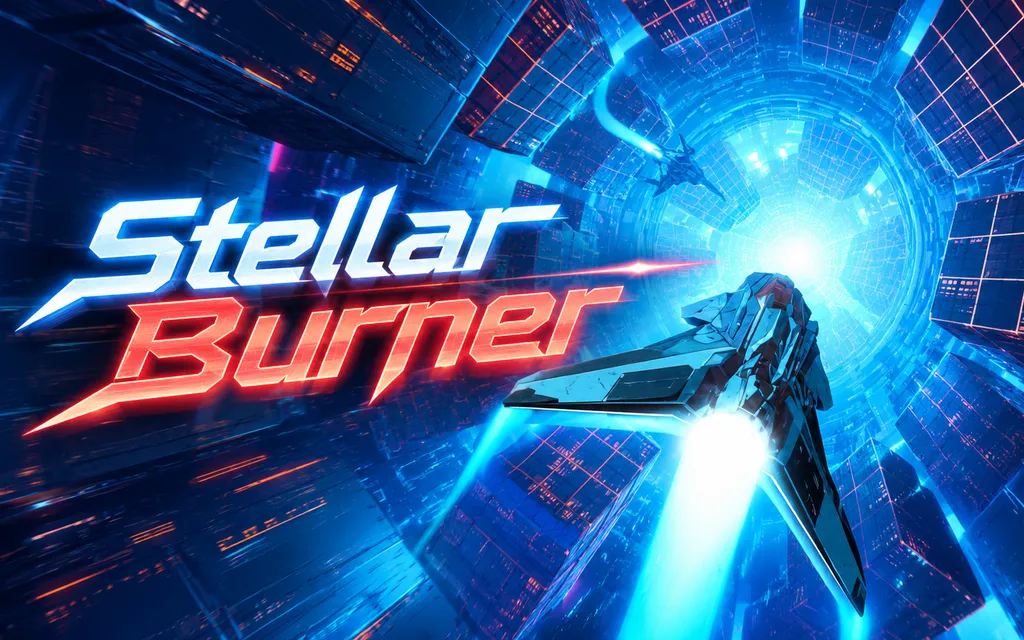
Stellar Burner
New Games











The core mechanic of Stellar Burner completely rejects the concept of deceleration. You are permanently locked into a state of forward acceleration, hurtling through claustrophobic cosmic trenches at terrifying speeds. The failure state in Stellar Burner is immediate and unforgiving; a single millimeter of miscalculation against the geometric walls results in instant vaporization. Every run in Stellar Burner is a pure, unfiltered test of twitch reflexes and spatial awareness under extreme velocity.
Entering the High-Speed Void
The Mechanics of Constant Acceleration
When the launch sequence initiates in Stellar Burner, the primary adversary isn't a fleet of enemy ships; it is the physical speed of your own vessel. The engine forces the spacecraft to continuously accelerate, meaning the window you have to react to incoming obstacles shrinks with every passing second. You cannot brake, and you cannot reverse in Stellar Burner. Your only defensive option is absolute lateral precision.
This mechanical commitment to speed is what gives Stellar Burner its uniquely oppressive atmosphere. The early sectors of a track might feel manageable, allowing you to gracefully weave through wide gaps. However, as the velocity multiplier ticks upward, the visual information on the screen blurs in Stellar Burner. You are forced to shift from conscious reaction to pure, unconscious muscle memory to survive the later gauntlets.
The physics engine dictates that your lateral movement speed remains static while your forward velocity increases. This means that at terminal velocity in Stellar Burner, your ship handles like a heavy brick. You must initiate your dodge maneuvers well before the obstacle is fully visible, anticipating the curve of the tunnel based entirely on split-second visual cues.
Navigating the Geometric Trenches
The level architecture in Stellar Burner is aggressively hostile. The tracks are not open space; they are enclosed, neon-lit trenches filled with interlocking geometric shapes. Massive pillars, spinning blades, and closing blast doors form a continuous barrage of hard physical boundaries. Clipping the edge of any of these structures in Stellar Burner instantly shatters your hull.
To survive the trench, you must understand the exact hitbox of your spacecraft. The visual model of the ship in Stellar Burner is slightly smaller than its actual collision box, particularly along the wingspan. Attempting to thread the needle through an impossibly tight gap often results in a wing clipping the barrier. You must aim for the absolute center of any opening in Stellar Burner to guarantee a clean pass.
"The absolute worst thing you can do in Stellar Burner is track the obstacles themselves. If you look at the walls, you will crash into the walls. You must lock your eyes on the negative space—the empty path between the hazards—and let your peripheral vision handle the alignment."
Mastering the Reflex Loop
The Precision of the Hitbox
Unlike standard flight simulators, Stellar Burner strips away complex pitch and yaw mechanics. You are operating on a strict 2D plane within a 3D environment, sliding left, right, up, and down. This arcade simplification means that your deaths are never the result of wrestling with complicated controls; they are always the result of a failed temporal calculation in Stellar Burner.
The hitboxes of the spinning obstacles are particularly brutal. A rotating fan blade in Stellar Burner has a dynamic collision zone that changes frame by frame. You cannot simply memorize a static path. You must calculate the rotational speed of the hazard and time your boost to pass through the gap exactly as it opens, a mechanic that requires absolute synchronization with the game's internal clock in Stellar Burner.
- Static Hitboxes: Massive walls and pillars that demand early lateral shifting in Stellar Burner.
- Dynamic Hitboxes: Moving doors and spinning blades that require temporal synchronization.
The Instant Restart Economy
Because failure is instantaneous and frequent, Stellar Burner employs a lightning-fast restart system. When your ship explodes, there are no long loading screens or penalty menus. The engine drops you immediately back at the starting line of the sector. This rapid iteration loop is the core psychological hook of Stellar Burner.
The instant restart mechanic encourages aggressive risk-taking. You are not meant to play safely in Stellar Burner; you are meant to crash dozens of times until your brain fully maps the sequence of the trench. The game transforms frustration into an obsessive desire to perfect the run. You will memorize the exact sequence of left-right-up-down inputs required to conquer a specific zone in Stellar Burner.
- Trial and Error: Leveraging the instant respawn to map hidden traps in Stellar Burner.
- Flow State: Entering a trance where inputs are executed purely via subconscious rhythm rather than active thought.
Understanding the Sensory Feedback
Reading the Neon Cues
The visual presentation in Stellar Burner is not just for aesthetic appeal; it is a critical source of telemetry data. The color of the upcoming geometric shapes often dictates their behavior. Static walls might glow with a cold blue, while moving hazards pulse with an aggressive red hue. Recognizing these color palettes instantly in Stellar Burner is vital for early threat assessment.
As your velocity increases, the edges of the screen begin to warp with motion blur. This visual distortion in Stellar Burner artificially narrows your field of view, forcing you to focus entirely on the dead center of the screen. You must train yourself to ignore the chaotic particle effects scraping across your hull and maintain absolute focus on the vanishing point at the end of the tunnel in Stellar Burner.
| System Specs | Details |
|---|---|
| Developer | Generic Studio |
| Release Year | 2023 |
| Genre | Spaceflight Arcade |
| Core Interaction | Velocity and Hitbox Avoidance |
Audio Synchronization
While Stellar Burner is not strictly a rhythm game, the electronic soundtrack is heavily tied to the pacing of the obstacles. The placement of major hazards often coincides with the heavy downbeats of the music. Subconsciously linking your evasive maneuvers to the tempo of the track can significantly improve your survival rate in Stellar Burner.
When the beat drops, you can expect a rapid succession of tight corridors. When the music strips back to ambient synths, you are usually entering a wider, less congested sector in Stellar Burner. Using audio cues to predict the upcoming architectural density allows you to pre-position your ship before the visual information is even rendered on screen.