

Neon Rush
New Games








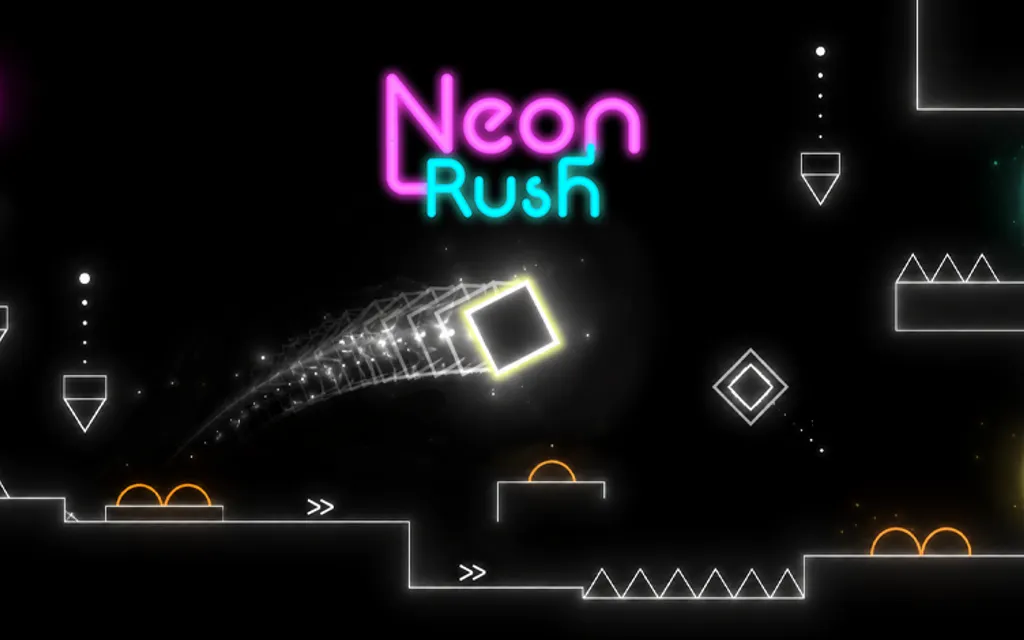
The core gameplay loop of Neon Rush is built entirely around audio-visual synchronization and unrelenting punishment. You control a glowing, geometric avatar propelled forward at a constant, unyielding velocity. There is no stopping, no slowing down, and no defensive mechanics in Neon Rush. The failure state is triggered instantly upon contact with any solid obstacle, instantly resetting your progress back to the beginning of the gauntlet.
Mastering the High-Speed Gauntlet
The Geometry of the Jump
In Neon Rush, your only form of interaction with the environment is the jump command. The physics engine determines your trajectory based on how long the input is held, creating a sliding scale of variable jump heights. Tapping the input results in a short hop over a small ground hazard, while holding it commits you to a massive, arcing leap required to clear wide chasms in Neon Rush.
The hitboxes in Neon Rush are completely unforgiving. The boundary of a spike trap is exact to the pixel. If the corner of your avatar clips the hazard, the run is over. This strict collision detection forces you to memorize the precise spatial requirements of every jump sequence, turning the game into a test of pure muscle memory rather than reactionary improvisation.
As the levels progress in Neon Rush, the environment begins to actively deceive you. What appears to be a safe landing platform might suddenly shift vertically on an unseen track, completely invalidating your calculated trajectory. You must anticipate these environmental shifts and adjust your inputs mid-air to survive the treacherous geometry of Neon Rush.
Audio-Kinetic Synchronization
Neon Rush is fundamentally a rhythm game disguised as a platformer. The placement of every hazard, jump pad, and safe zone is meticulously tied to the underlying electronic soundtrack. A heavy bass drop invariably signals a massive vertical leap, while a rapid succession of snare hits dictates a frantic sequence of micro-jumps in Neon Rush.
Playing Neon Rush without audio is virtually impossible. The visual cues alone are not enough to process the sheer speed of the incoming obstacles. You must internalize the beat and let the tempo guide your fingers, striking the input button in perfect time with the music to clear the hardest sectors of Neon Rush.
"The secret to Neon Rush isn't having fast eyes, it's having good ears. You aren't watching the obstacles approach; you are playing along to the sheet music that the developer laid out using spikes and platforms."
Navigating Complex Obstacle Formations
The Inversion Mechanics
Midway through the campaign, Neon Rush introduces gravity-inverting portals. Passing through these neon rings instantly flips your avatar's orientation, slamming you onto the ceiling. The fundamental mechanics remain the same, but the cognitive load required to process inverted jumps at maximum velocity in Neon Rush often breaks the player's concentration.
The engine frequently chains these portals together in rapid succession in Neon Rush. You will be forced to jump from the floor, pass through a portal mid-air, and immediately execute a secondary jump off the ceiling to avoid an incoming hazard. This rapid context switching demands absolute mechanical precision and mental flexibility in Neon Rush.
- Standard Gravity: Traditional arc physics applied to jumping mechanics in Neon Rush.
- Inverted Gravity: Forces the player to mirror their spatial reasoning instantly upon passing a portal.
Momentum Manipulation Pads
Scattered throughout the tracks in Neon Rush are specialized surface pads that radically alter your velocity vectors. Yellow pads launch your avatar high into the stratosphere, bypassing large sections of ground hazards. Pink pads, however, function as immediate momentum stops, forcing you to execute a standing jump from a dead halt before the screen scrolling kills you in Neon Rush.
Interacting with these pads requires zero input; simply making contact with the surface triggers the physical override in Neon Rush. However, you must immediately prepare for the resulting velocity shift. Being launched into the air means you have a longer hang time to calculate your landing, but hitting a pink pad requires instantaneous reflex activation to prevent a collision in Neon Rush.
- Launch Pads: Overrides standard jump physics to propel the avatar vertically.
- Brake Pads: Kills all horizontal momentum, demanding a zero-velocity standing jump.
The Pursuit of the Perfect Run
Frame-Perfect Micro-Adjustments
In the most punishing sectors of Neon Rush, the gaps between spike formations are exactly wide enough for your avatar to pass through. There is zero margin for error. A jump initiated one frame too early means clipping the front spike; one frame too late means striking the back spike in Neon Rush.
This level of precision requires breaking the level down into distinct chunks. Veteran players of Neon Rush do not look at the level as a whole; they focus entirely on surviving the next 10 seconds of gameplay. By isolating these micro-sections, you can drill the specific input timings required to pass the chokepoint consistently in Neon Rush.
| System Specs | Details |
|---|---|
| Developer | Indie Studio |
| Release Year | 2024 |
| Genre | Rhythm Platformer |
| Core Interaction | Audio-Synced Jumping |
Analyzing the Death Loop
Dying in Neon Rush is not a punishment; it is a learning mechanism. Because the levels are completely static and deterministic, every death provides critical data regarding the timing of your previous input. If you hit a wall, your jump was too short. If you landed in a pit, you initiated the jump too early in Neon Rush.
The instant respawn system ensures that the frustration loop is minimized, throwing you immediately back into the action. You must use this rapid iteration cycle in Neon Rush to physically wire the correct input sequences into your muscle memory. The goal is to reach a state of flow where the conscious mind turns off and the hands simply react to the music.