

2 Player Dino Run
New Games





Surviving the Prehistoric Chaos in 2 Player Dino Run
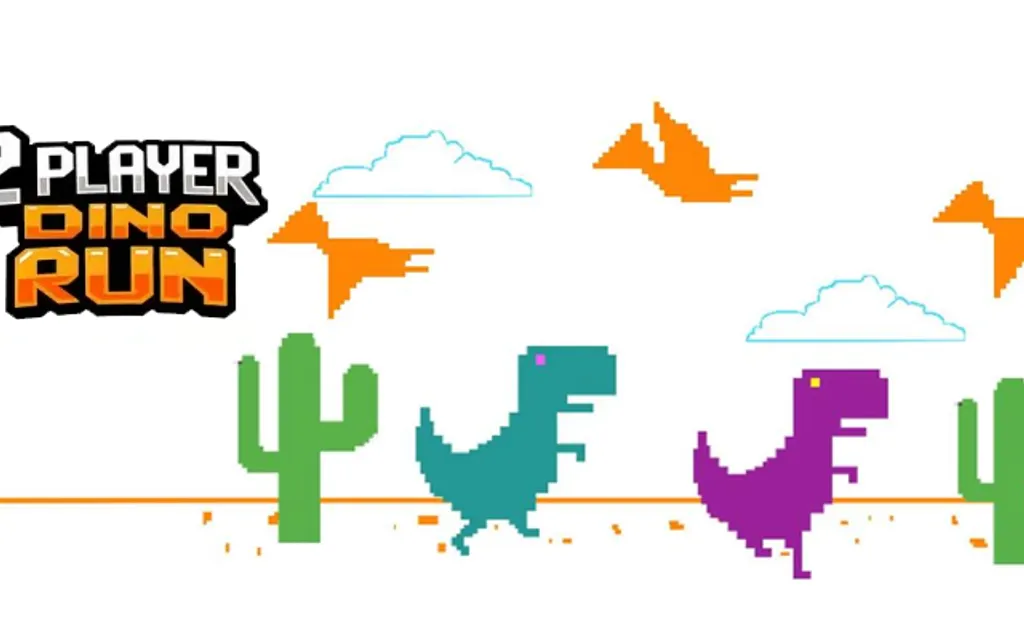
If you have fond memories of intentionally disconnecting your internet just to play that classic pixelated dinosaur hopping over cacti, then booting up 2 Player Dino Run will instantly feel like coming home—except this time, you brought a friend along for the ride. As a massive fan of local multiplayer games that inevitably end in screaming matches, I can confidently state that 2 Player Dino Run successfully transforms a solitary distraction into a fiercely competitive arena. The brilliance of 2 Player Dino Run lies in its absolute simplicity. There are no convoluted skill trees, no pay-to-win microtransactions, and no sprawling open worlds to get lost in. You are just a tiny T-Rex sprinting for survival against an ever-accelerating scrolling screen. But when you add a second player on the exact same keyboard, the dynamics of 2 Player Dino Run completely shift. Suddenly, you are not just fighting the procedurally generated obstacles; you are fighting the psychological pressure of watching your opponent cleanly vault over a hazard that is rapidly approaching your own character. It is an adrenaline-fueled test of reaction time that proves you don't need photorealistic graphics to create an incredibly engaging local multiplayer experience.
Mastering the Twin Mechanics: Duck and Jump
The mechanical floor of the game is about as low as it gets, which makes it incredibly accessible for literally anyone. In 2 Player Dino Run, your entire survival depends on just two inputs: jumping and ducking. However, do not mistake accessibility for a lack of depth. The physics engine in 2 Player Dino Run dictates that your jump arc is fixed. Once your feet leave the ground in 2 Player Dino Run, you are entirely committed to that trajectory. This means that pressing the jump key a fraction of a second too early will result in you landing directly on top of a spiked cactus. Conversely, the ducking mechanic in 2 Player Dino Run is essential for slipping underneath the low-flying pterodactyls that periodically swarm the screen. Knowing exactly when to stay grounded and slide under a threat, rather than instinctively jumping, is what separates novice runners from the true veterans.
The Brutal Speed Scaling
What makes a match so incredibly stressful is the relentless acceleration of the game world. When a round of 2 Player Dino Run begins, the scrolling speed is leisurely, giving you plenty of time to visually parse the upcoming obstacles. But as the match progresses, 2 Player Dino Run ramps up the velocity to absurd, eye-watering speeds. At the highest tiers of speed in 2 Player Dino Run, your conscious brain literally cannot process the information fast enough; you have to rely entirely on pure muscle memory and instinct. Surviving the late-game phases of 2 Player Dino Run induces a genuine flow state where blinking for even a millisecond guarantees immediate extinction.
The Psychology of Couch Competition
Playing this game solo is fine for practice, but the soul of the experience resides entirely in the local multiplayer mode. 2 Player Dino Run is engineered to test friendships. Because both players are sharing the same screen and often the same physical keyboard, the meta-game of 2 Player Dino Run extends outside the digital realm. I have seen players actively try to distract their opponent during a critical jump in 2 Player Dino Run, engaging in mild psychological warfare just to secure a win.
The Best-of-Three Tournament Structure
A single mistake is rarely the end of the war, thanks to the structured match format. Every competition in 2 Player Dino Run is played as a best-of-three series. This is a brilliant design choice because it allows for dramatic comebacks and prevents a lucky early mistake from ruining the experience. If you accidentally clip a cactus in the opening seconds of 2 Player Dino Run, you still have two more rounds to redeem yourself. Winning that final, tie-breaking round in 2 Player Dino Run after being down one point is an incredible feeling of vindication.
Dealing with Screen Distractions
One of the most challenging aspects of the competitive mode is simply maintaining focus on your specific character. In 2 Player Dino Run, both dinosaurs are sprinting side-by-side, navigating the exact same obstacle course simultaneously. It is incredibly easy to accidentally track your opponent's dinosaur instead of your own. When your friend jumps early in 2 Player Dino Run, your brain often misfires and forces you to mirror their action, leading directly into a trap. Training your eyes to completely ignore the other player while still feeling the pressure of their survival is the highest skill ceiling in 2 Player Dino Run.
Analyzing the Prehistoric Hazards
The enemies you face are not complex AI entities; they are static and predictable, yet they still manage to end countless runs. The game relies on procedural generation to create a unique track every single round, meaning you can never simply memorize the layout.
The Cactus Clusters
The most common threat you will face are the cacti. Initially, 2 Player Dino Run throws single, isolated cacti your way. But as the difficulty scales, 2 Player Dino Run begins generating massive clusters of varying heights and widths. Clearing a triple-wide cactus patch in 2 Player Dino Run requires a perfectly timed maximum-height jump. If you hesitate for even a frame, your dino's pixelated toes will clip the thorns, instantly ending your run.
The Pterodactyl Mix-ups
The introduction of the flying pterodactyls completely changes the rhythm of the game. These aerial threats in 2 Player Dino Run spawn at three distinct altitudes: high (which you can safely run under), medium (which forces you to duck), and low (which forces you to jump). The genius of 2 Player Dino Run is how it combines these threats. Being forced to jump over a low pterodactyl directly into a duck to avoid a medium pterodactyl in 2 Player Dino Run is a brutal mechanical check that will break the fingers of unprepared players.
Strategies for Consistent Victory
If you want to absolutely dominate your friends and secure bragging rights, you cannot just rely on blind luck. You need to develop a consistent strategy for handling the late-game speed. The most common mistake beginners make in 2 Player Dino Run is tracking the obstacles directly in front of their character.
Shifting Your Focal Point
To survive the high-speed phases of 2 Player Dino Run, you must shift your visual focal point to the far right edge of the screen. By looking ahead in 2 Player Dino Run, you give your brain those precious extra milliseconds to process whether the incoming shape is a cactus or a bird. Relying purely on peripheral vision to time your actual jumps in 2 Player Dino Run is a technique adopted by all high-level players.
The Patience of Ducking
Another crucial tip is to over-utilize the duck mechanic. When the screen gets chaotic in 2 Player Dino Run, panicked players tend to jump constantly, hoping to clear threats by sheer verticality. But in 2 Player Dino Run, spending time in the air leaves you incredibly vulnerable to unexpected mid-height spawns. Staying low and only jumping when absolutely necessary is the safest way to extend your run.
Final Verdict: Pure Pixelated Joy
In an era dominated by massive, hundred-gigabyte games that require hours of tutorials, this title is a breath of fresh air. It distills the competitive gaming experience down to its absolute most primal components: reflexes, focus, and the burning desire to outlast your friend by just one more second. 2 Player Dino Run is the perfect palate cleanser between heavier games, and an absolute must-have for any local multiplayer rotation. The simple joy of watching your opponent slam face-first into a pixelated cactus while you soar cleanly over it is a feeling that 2 Player Dino Run delivers perfectly every single time. Grab a keyboard, grab a friend, and prepare for some intense prehistoric racing.