

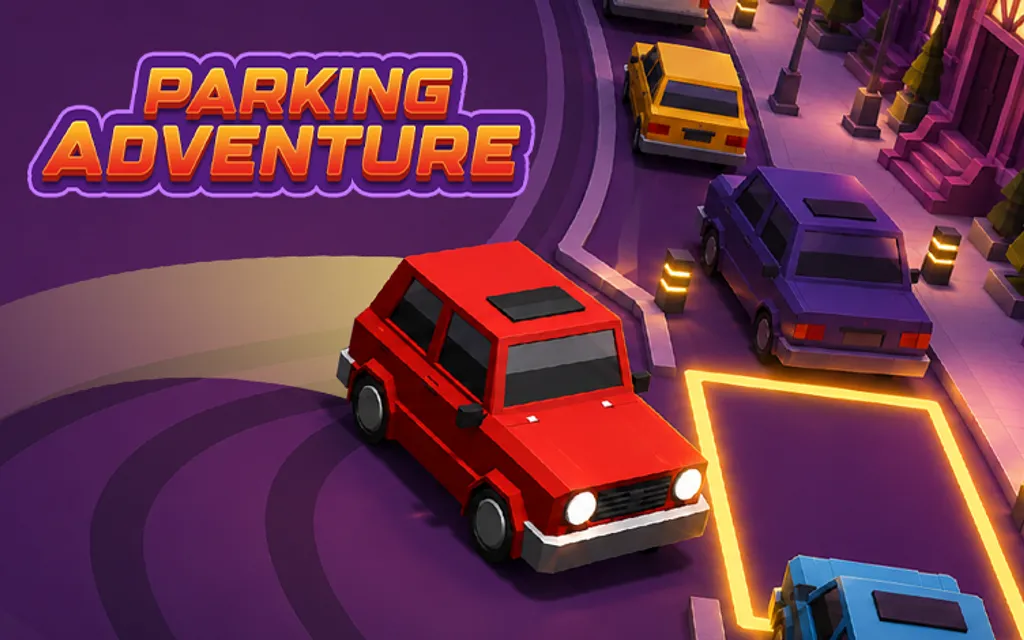
Parking Adventure
New Games











The core mechanic of Parking Adventure elevates the mundane task of vehicular storage into a high-stakes arcade gauntlet. You are thrust into aggressively congested urban environments where spatial awareness and absolute temporal precision are mandatory. The failure state in Parking Adventure is triggered by the slightest miscalculation in trajectory; scraping a curb, tapping a pedestrian, or clipping a barrier results in instant termination of the run. Securing a spot requires mastering the physics of vehicular drift under extreme time pressure.
Dropping into the Asphalt Grid
The Mechanics of the Turn Radius
When you take control of a vehicle in Parking Adventure, you are not driving a hyper-responsive sports car; you are managing a heavy machine bound by strict physics parameters. The engine of Parking Adventure simulates a realistic turning radius, meaning you cannot pivot on a dime. Approaching a tight parallel spot at high speed will inevitably result in severe understeer, driving the nose of your car directly into the bumper of the adjacent vehicle in Parking Adventure.
To successfully navigate the tight lots, you must understand the concept of the swing arc. When you turn the wheel sharply in Parking Adventure, the rear chassis of the car swings out in the opposite direction. Failing to account for this rear-end displacement is the leading cause of collisions. You must leave enough lateral space between your vehicle in Parking Adventure and the environmental hazards to accommodate the tail-swing during sharp maneuvers.
This mechanical reliance on spatial geometry forces you to plan your approach vectors well in advance in Parking Adventure. You cannot simply react to the parking spot when you see it. You must pre-align your chassis, decelerate to a manageable velocity, and initiate the steering input at the exact optimal angle to slide into the designated zone.
Managing the Time Economy
The urban layout in Parking Adventure is not static; it is a hostile, ticking clock. Every level enforces a strict countdown timer that represents your fuel or patience gauge. Idling in the middle of the street while trying to perfectly align your tires drains this resource rapidly. You are heavily incentivized to execute aggressive, fluid maneuvers rather than slow, cautious adjustments in Parking Adventure.
Furthermore, the premium parking spots are often ephemeral. The engine of Parking Adventure will generate a glowing zone that actively shrinks over time. If you fail to lock your chassis within the boundaries of the zone before it vanishes, you lose the economic bonus associated with that specific spot in Parking Adventure. This forces a constant psychological battle between the need for speed and the demand for zero-collision precision.
"The most critical skill in Parking Adventure is the art of the handbrake pivot. Standard braking is too slow for the timed zones. You have to approach at an angle, rip the e-brake to slide the rear end perfectly into the slot, and immediately cut the engine of Parking Adventure. It is a high-risk physics exploit that Parking Adventure actively rewards."
Mastering the Vehicular Arsenal
Adapting to Vehicle Archetypes
As you progress and earn currency, you unlock different classes of vehicles in Parking Adventure. Each chassis fundamentally alters the physics equation. Upgrading from a compact hatchback to an elongated sedan drastically changes the length of your hitbox and widens your turning circle. A cornering strategy that worked perfectly in the early stages will result in catastrophic failure when driving a heavy SUV.
You must re-calibrate your muscle memory every time you switch vehicles in Parking Adventure. The heavier cars have greater momentum, requiring you to initiate braking much earlier in the sequence. Conversely, the sports cars have hypersensitive steering that easily leads to over-correction and fishtailing if you apply too much lateral input during the approach vector.
- Compacts: Tight turning radius but highly sensitive to over-steering in Parking Adventure.
- SUVs: Massive hitboxes requiring wide, sweeping approach arcs to avoid clipping.
Navigating Dynamic Traffic
The parking lots are not empty. The engine spawns dynamic AI vehicles that patrol the lanes in Parking Adventure. These AI cars do not yield, and their pathfinding routines are rigidly set. Attempting to cross an intersection while an AI vehicle is on an intercept course is a guaranteed collision.
You must treat the moving traffic as a temporal obstacle course. To secure a spot located across a busy lane in Parking Adventure, you must calculate the velocity of the oncoming AI and execute your maneuver entirely within the gap between their bumpers. Parking Adventure demands that you read the traffic flow and synchronize your acceleration perfectly to avoid being T-boned.
- Linear AI: Vehicles that move straight, requiring simple timing calculations to bypass.
- Erratic AI: Pedestrians or carts that change direction, forcing emergency braking in Parking Adventure.
Analyzing the Visual Indicators
Reading the Alignment Box
The ultimate objective of every stage is the alignment box—a colored rectangle painted on the asphalt. To trigger a successful completion state in Parking Adventure, all four tires of your vehicle in Parking Adventure must rest entirely within this geometry. Leaving a bumper hanging over the line prevents the stage from ending, leaving you vulnerable to the ticking clock.
The box often changes color based on your alignment accuracy. Green indicates a perfect lock, while yellow implies you are skewed. If you are rushing to beat the timer in Parking Adventure, you must learn to accept a yellow alignment. Attempting to reverse and straighten out a slightly crooked park wastes crucial seconds and massively increases the risk of a late-stage collision.
| System Specs | Details |
|---|---|
| Developer | Generic Studio |
| Release Year | 2023 |
| Genre | Arcade Precision |
| Core Interaction | Trajectory & Collision Management |
The Camera Angle Constraint
The isometric perspective heavily distorts your perception of depth and distance. When navigating between two parked cars, the visual gap often appears wider than the actual mathematical collision boundaries. You must train your brain to trust the physics engine rather than the raw visuals in Parking Adventure.
If a gap looks suspiciously tight, it is almost certainly a trap. The level design frequently utilizes visual occlusion—hiding concrete bollards or shopping carts directly behind the pillars of the environment. You must swing your car wide to gain a clear line of sight before committing to a blind turn into an obscured alleyway in Parking Adventure.